

Geoffrey Bawa buildings often reveal their beauty through the landscape around them, rather than through shape alone. A leading Sri Lankan architect, Bawa made gardens, water, local materials, and carefully framed views central to his work.
His hotels and public buildings invite you to notice the relationship between indoors and outdoors, including what happens along a shaded corridor. These five sites show how differently that relationship can unfold, beginning with a forest hotel, a country estate, and a coastal retreat.
Five Geoffrey Bawa buildings in Sri Lanka that blend into nature
These places reward attention to terrain and greenery, but also to movement: the approach often matters as much as arrival.
Heritance Kandalama, a hotel embraced by forest and rock
Near Dambulla, Heritance Kandalama follows rocky ground beside Kandalama Lake. Its long, low profile fits against the hillside, while vegetation covers roofs and trails over parts of the structure.
Open corridors keep the forest close. Elsewhere, openings frame the water and distant Sigiriya rock. Although this is a substantial hotel, its shaded circulation spaces repeatedly return your attention to the surrounding landscape.
Lunuganga, Bawa's country home shaped by its gardens
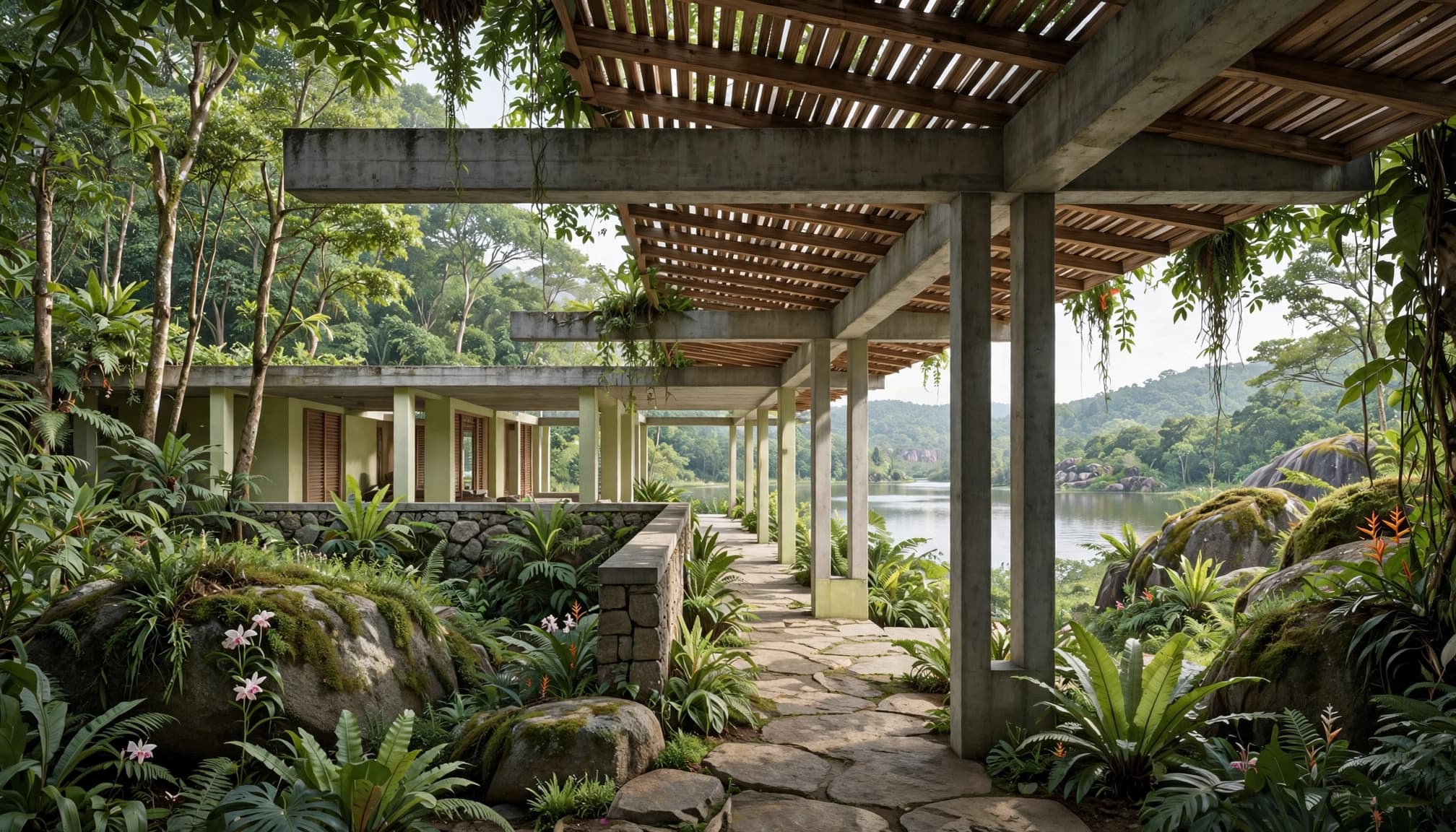
Bawa developed Lunuganga near Bentota between 1948 and 2003. Here, the estate is the work, rather than any single building.
Paths, terraces, lawns, and small structures form a sequence of changing views. A turn can reveal water or redirect attention toward a pavilion. Because buildings and planting work together, walking through the garden becomes an architectural experience.
Bentota Beach Hotel, where courtyards soften the coastal setting
The original Bentota Beach Hotel, now Cinnamon Bentota Beach, is one of Bawa's major hotel designs. Its courtyard plan creates sheltered spaces within the coastal setting.
Tropical planting and shaded passages soften the transitions between rooms and outdoor areas. Rather than disappearing into the beach, the architecture establishes a protected interior world, with openings that maintain contact with the surrounding coast.
Two more Bawa landmarks shaped by water and place
Water takes on a different role in these civic and religious settings. It creates breathing room around buildings within the Colombo area.
Seema Malaka, a temple pavilion floating above Beira Lake
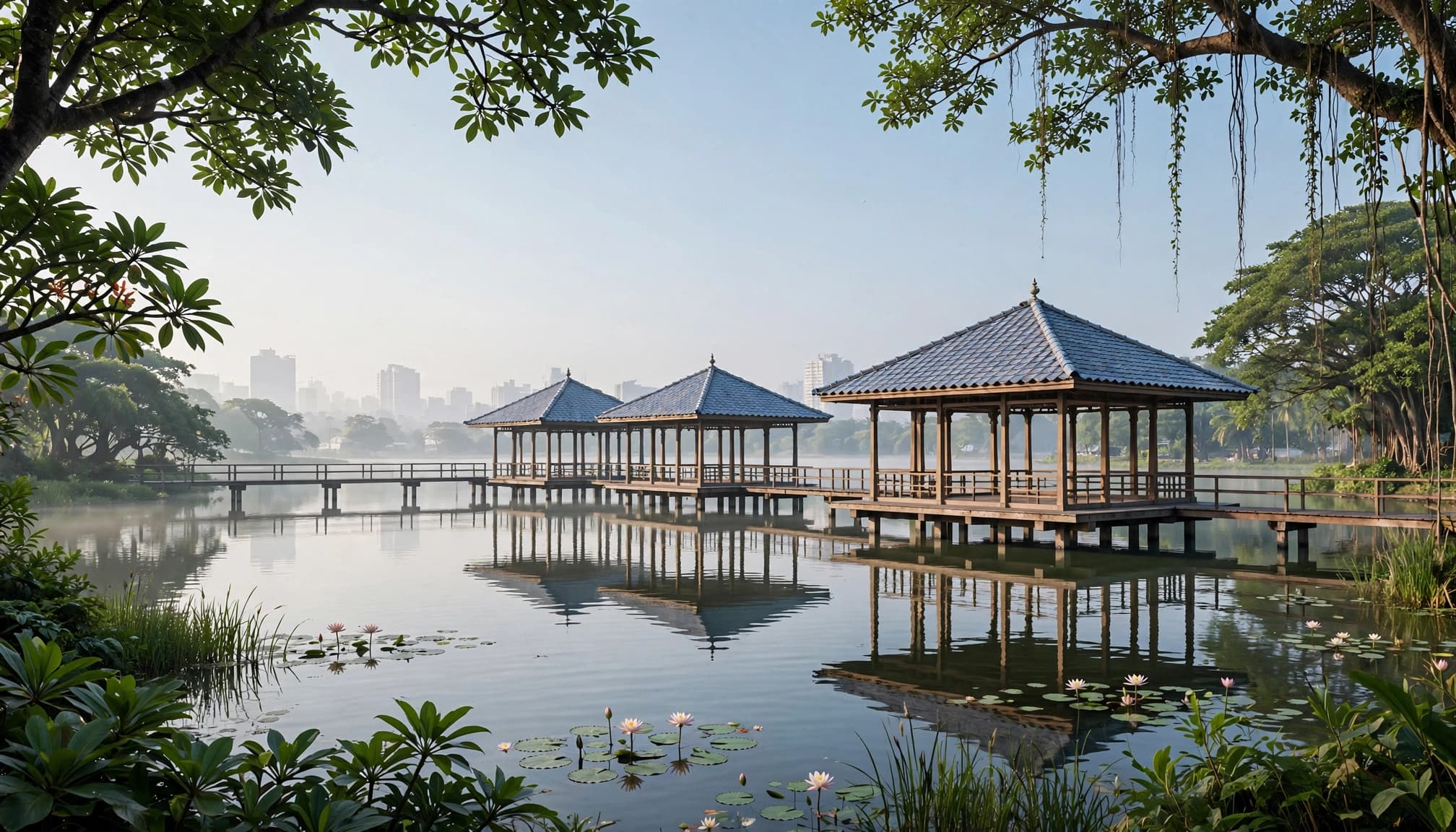
Seema Malaka in Colombo consists of pavilions on platforms above Beira Lake. Their low roofs and open sides allow views across the water, while nearby trees soften the city backdrop.
The apparent floating quality comes from this separation between the platforms and the shore. However, Seema Malaka remains a Buddhist place of worship. Its calm setting supports religious practice, so visitors should treat it as more than a photographic stop.
Sri Lanka's Parliament, set among water and greenery
Bawa's Sri Lankan Parliament complex occupies an island in the Diyawanna Oya at Sri Jayawardenepura Kotte. Landscaped grounds surround its grouped buildings, whose roof forms draw on Sri Lankan traditions.
The water gives the complex a distinct separation from surrounding roads and development. Seen across the lake, the broad roofs and greenery establish its public presence without relying on a single towering facade.
The design choices that make Bawa's architecture feel at home
Tropical modernism combines modern architectural planning with responses to tropical climate and local ways of building. In Bawa's work, that meant treating heat, rain, vegetation, and outdoor life as design conditions.
Courtyards bring daylight and planted space into a plan. Deep shade makes transitional areas more comfortable, while open-sided passages and carefully positioned openings encourage natural ventilation. These choices also create places to pause between enclosed rooms and exposed gardens.
Local materials, including timber, stone, and clay roof tiles, connect buildings to familiar construction traditions. Meanwhile, framed views give ordinary movement a clear direction: a doorway or corridor can draw your eye toward water or a distant tree.
As architectural coverage of experiencing Bawa's work in person emphasizes, presence matters. You understand these arrangements through changing light and movement, not just a facade photograph.
Across these Geoffrey Bawa buildings, the site shapes the plan. The shared principles never become one fixed appearance.
How to experience Geoffrey Bawa's architecture on a Sri Lanka trip
These five places are spread across several regions, so visiting them all in one day isn't realistic. Group them by geography instead.
Seema Malaka and Parliament belong to the Colombo-area portion of a trip. Lunuganga and Cinnamon Bentota Beach make a natural coastal pairing around Bentota. Heritance Kandalama fits a separate inland stay near Dambulla and Sigiriya.
Access also differs. The hotels are working hospitality properties, so don't assume that every architectural space is open to walk-in visitors. A room or dining reservation may provide access, while other visits require permission. Lunuganga offers organized garden visits rather than unrestricted wandering through a public park.
At Seema Malaka, dress modestly, remove footwear where required, and give worshippers space. Parliament has security-controlled access; viewing the complex across the water is different from entering it.
Allow time to walk slowly. Approaches, corridors, and garden paths are central to how these places reveal themselves.
Notice the Landscape as Closely as the Building
Forest, gardens, coast, and lake give these five works their different characters. Bawa's lasting influence comes from making architecture respond to those conditions with care.
When exploring Geoffrey Bawa buildings in Sri Lanka, look beyond the roofline or facade. Notice what the building lets you see, where it offers shade, and how it brings the surrounding landscape into everyday experience.